Arab Muslim World: Architect of Slavery in Africa (1) by Jean Marie Dia
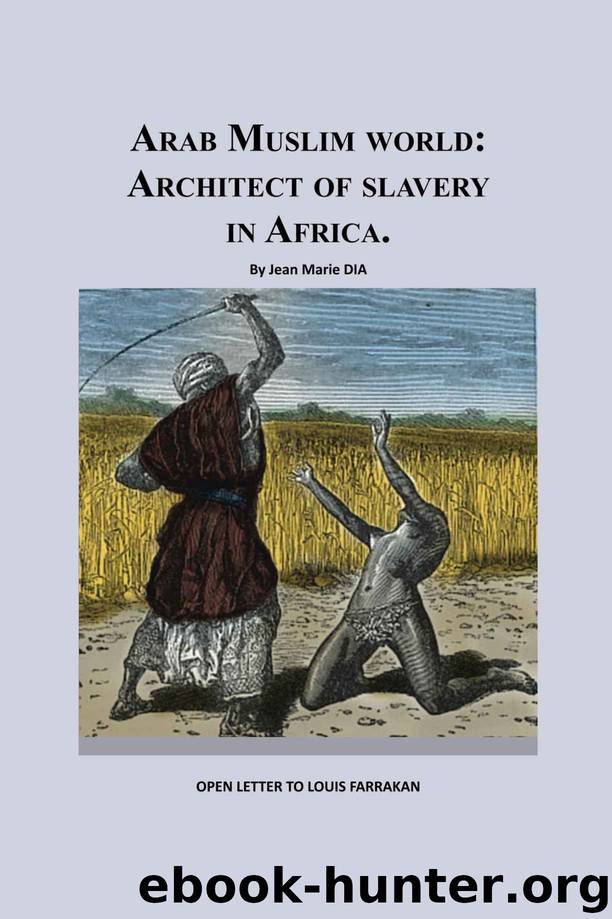
Author:Jean Marie Dia [Dia, Jean Marie]
Language: eng
Format: azw3
Publisher: Jean Marie Dia (Deluxeauthor).
Published: 2013-11-29T05:00:00+00:00
1511
During the 16th century, the Portuguese reserved themselves essentially to the slave trade along the African coast. Subsequently, the Spanish, English, Dutch, French, Danish also launched in this trade. This traffic took in the history the special name of triangular trade. Indeed, ships left ports of Lisbon, Cadiz, Nantes, Bordeaux, Le Havre, Liverpool, Amsterdam taking junk, fabrics, weapons, alcohol, beads ... to Africa where they exchanged these products against slaves. Those latter was then transported to America in the respective colonies of these different European nations. Vessels back to their home ports from America carrying precious metals, spices, cotton, and tobacco, indigo. Asimilar trip lasted 18 months.
One more time, it is difficult to give exact figures on the losses suffered by Africa in Men. The estimated number of slaves transported to America during the three centuries that the slave trade lasted is about 28 million, a figure which must be added those who died of diseases and deprivation during the trip and before shipment. For example, in the late 18th century, British transported annually about 75,000 slaves, 60,000 for French, Portuguese carried only at that time 15 000.
On the west coast, European traders has indulged themselves rarely in the populations raids, but took advantage of divisions and wars among African tribal leaders, sometimes fanning by them and bought prisoners from these quarrels. Among European factories in Africa, the island of Sao Tome, then the port of Luanda and further north the port of Elmina, were greats slave markets or rather the main points of embarkation of slaves.
Regions of America where black slaves were preferably installed were: For Portugal: Brazil. The Bantu of southern Africa were transported to the provinces of Rio and Sao Paulo, and Sudanese to the city of Bahia.
For Spain: Venezuela, Honduras, Mexico, Florida, Cuba and Puerto Rico. For France: French Guyana, Louisiana, Guadeloupe and Martinique, Haiti. For Holland: The Dutch Guyana and the Island of Trinidad. For England: English Guyana, the Bahamas, especially the North American colonies, Maryland, Virginia, Carolina and Georgia.
The plight of black slaves in America was not only, not be reduced to slaves, but also find themselves separated from their Traditions and do not form a homogeneous group. Indeed, these slaves were intermingled without regard to their geographical origin and their religious affinities.
However, they could not reconstitute Africa on American soil, but they maintained their traditions, especially their songs and their beliefs. They adopted the religion of their masters, but that Christianity was for many, relatively superficial, as they clung too many of their rituals and their traditional beliefs, even if these beliefs changed profoundly. In some countries of South America especially in Brazil, blacks mixed quite rapidly to the Indian or European population. In the Anglo-Saxon America instead, they formed up in recent year, a separate groups which in some U.S. states, remained a minority.
Download
This site does not store any files on its server. We only index and link to content provided by other sites. Please contact the content providers to delete copyright contents if any and email us, we'll remove relevant links or contents immediately.
The Art of Coaching Workbook by Elena Aguilar(51134)
Trainspotting by Irvine Welsh(21606)
Twilight of the Idols With the Antichrist and Ecce Homo by Friedrich Nietzsche(18599)
Fangirl by Rainbow Rowell(9208)
Periodization Training for Sports by Tudor Bompa(8236)
Change Your Questions, Change Your Life by Marilee Adams(7715)
This Is How You Lose Her by Junot Diaz(6854)
Asking the Right Questions: A Guide to Critical Thinking by M. Neil Browne & Stuart M. Keeley(5734)
Grit by Angela Duckworth(5574)
Red Sparrow by Jason Matthews(5446)
Paper Towns by Green John(5157)
Room 212 by Kate Stewart(5087)
Ken Follett - World without end by Ken Follett(4701)
Housekeeping by Marilynne Robinson(4418)
The Sports Rules Book by Human Kinetics(4363)
Double Down (Diary of a Wimpy Kid Book 11) by Jeff Kinney(4252)
Papillon (English) by Henri Charrière(4235)
The Motorcycle Diaries by Ernesto Che Guevara(4068)
Exercise Technique Manual for Resistance Training by National Strength & Conditioning Association(4048)
